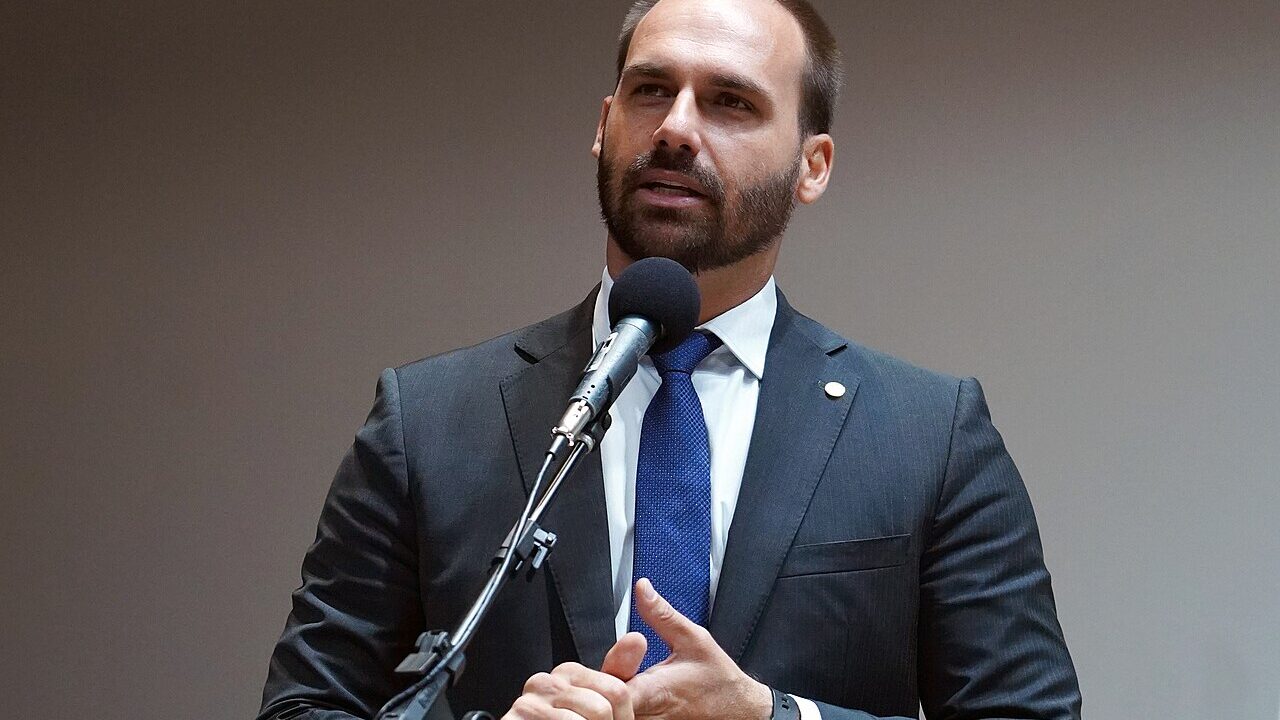
Eduardo Bolsonaro has spent months building a political life in Texas. This week, Brazil’s Supreme Court moved to make that distance a legal problem, after Justice Alexandre de Moraes issued an arrest warrant for the former congressman and son of ex-president Jair Bolsonaro.
The warrant lands on top of a four-year prison sentence handed down in June. Brazilian authorities have already cancelled his passport, and prosecutors have treated his continued stay in the United States — where he holds residency through a green card — as flight from the sentence rather than exile. De Moraes, the justice who has overseen the sprawling cases arising from the Bolsonaro era, has now converted that assessment into a formal order for his arrest.
Eduardo Bolsonaro, 41, was once one of the most recognisable faces of Brazil’s hard right: a federal deputy from São Paulo, a prolific presence on social media, and a frequent visitor to conservative circles in the United States long before his legal troubles began. From Texas he has continued to campaign against Brazil’s judiciary, portraying the cases against his family as political persecution — a framing the court’s majority has rejected in ruling after ruling.
What happens next depends on geography as much as law. An arrest warrant issued in Brasília does not execute itself in Texas, and any Brazilian move to seek his return would run through extradition channels that are slow, political and anything but guaranteed. For now, father and son occupy mirror-image positions: Jair Bolsonaro fighting his own legal battles at home, Eduardo fighting Brazil’s courts from abroad, each insisting the other is the true face of the movement they built together.
The warrant also raises the temperature inside Brazil, where the Bolsonaro family’s legal saga has become the defining fault line of national politics. Supporters read each new judicial step as proof of overreach; the court’s defenders read the same steps as the rule of law finally catching up. The arrest order for the younger Bolsonaro ensures that argument, at least, will not be cooling down soon.
Related reading: Putin and Pezeshkian Take Center Stage as CIS Leaders Mark 35 Years in Avaza · In Putrajaya, Anwar Ibrahim Sits Down With Myanmar's Min Aung Hlaing · Baghdad Says No: Iraq Refuses Syria's Request to Take Back IS Detainees