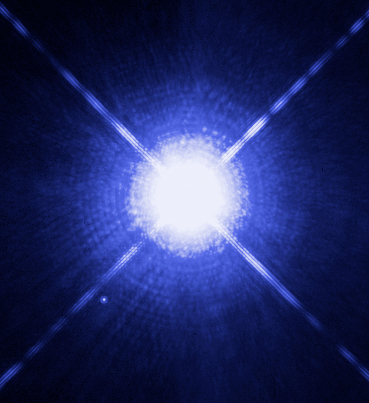
Astronomers have found evidence that a white dwarf — the burned-out core of a sun-like star — may be assembling something it has no business owning: a new generation of planets. The candidate world orbits HS 0209+0832, a white dwarf roughly 270 light-years away, and if confirmed, it would be the first known example of a “second-generation planet” forming from the debris of a destroyed first one.
The clues are written in the star’s own pollution. White dwarfs have pristine hydrogen atmospheres, so anything heavier found there must have fallen in recently — the residue of asteroids or planetary fragments shredded by the star’s gravity. At HS 0209+0832, that residue is rich in niobium, an unusual chemical signature pointing to material that was once part of a differentiated, planet-like body. Separately, NASA’s TESS telescope has recorded a repeating 4.4-day signal consistent with an object transiting the tiny stellar remnant.
The study, published in Nature Astronomy and led by Jamie Williams of the University of Warwick, threads these two facts into a provocative story. When the original star died and expanded, it would have engulfed or destabilised its inner planets. But the surviving debris disc — ground-down remains of the first system — may have clumped back together into a new world: a planet born not with the star, but from the star’s wreckage.
The hypothesis needs the caution the researchers themselves apply. Transit signals around white dwarfs are hard-won and easily mimicked, and the chemistry tells a story about accreted rubble, not directly about a planet. What makes the result exciting even in candidate form is that it is testable: further observations can confirm or kill the 4.4-day signal, and every polluted white dwarf becomes a suspect for the same phenomenon.
Planet formation has always been framed as a one-act play: disc, planets, star dies, curtain. HS 0209+0832 suggests a second act may be possible — worlds rebuilt from the bones of worlds. For a universe that recycles everything else, it would be strange if planets were the exception.
Related reading: NASA's Picture of the Day Is a Crater Named for the Woman Who Moved a Telescope's Maker · Bonn Scientists Wind an 80-Year-Old Cell's Clock Back to Twenty · An Inflammation Protein Helps Build Pancreatic Tumours. Blocking It Slows Them Down.