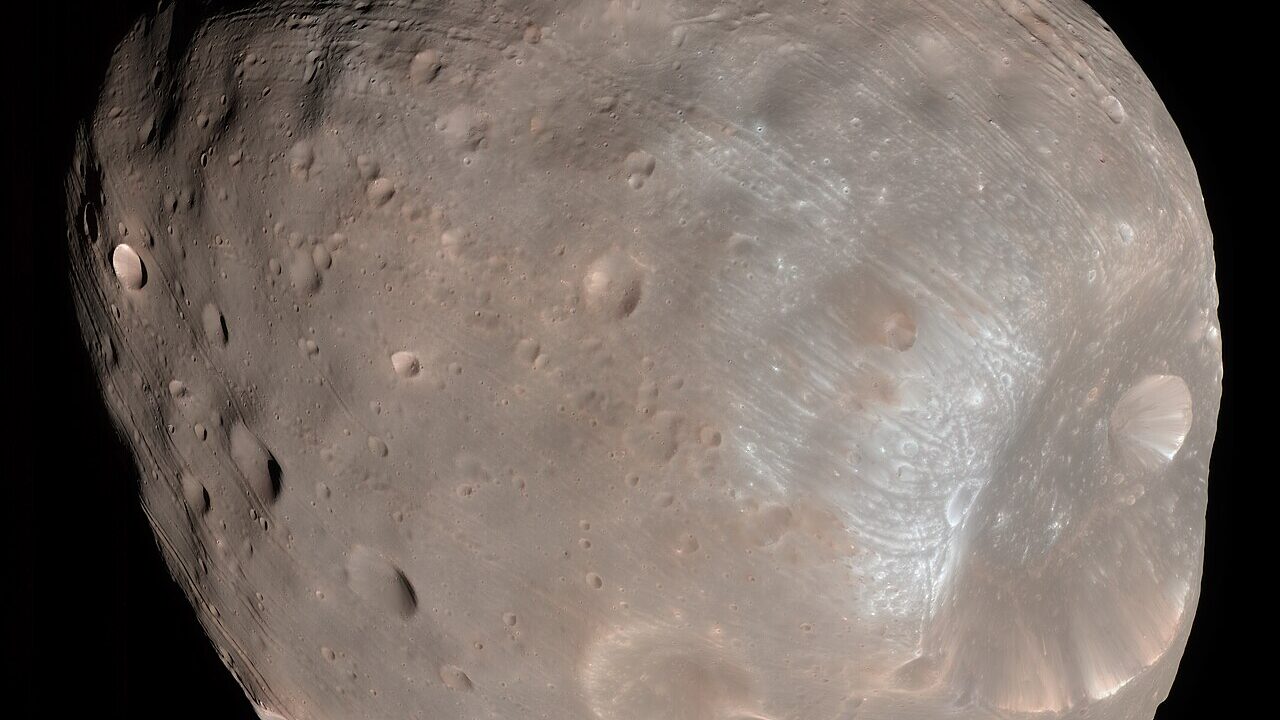
NASA’s Astronomy Picture of the Day for October 9 turns its gaze to one of the solar system’s most battered landscapes: Stickney Crater, the great wound on the surface of Phobos, the larger of Mars’s two moons. The image, captured by the HiRISE camera aboard the Mars Reconnaissance Orbiter, shows a crater nearly half the diameter of the moon it scars — the mark of an impact that came close to shattering Phobos outright.
Stickney’s name carries a story the crater’s violence almost hides. It honours Chloe Angeline Stickney Hall, a nineteenth-century mathematician whose calculations of Phobos’s orbit helped her husband, astronomer Asaph Hall, discover both Martian moons in 1877. Her computational work was essential and, in the fashion of the era, largely uncredited in her lifetime; the largest crater on Phobos is her monument, named by a science that took a century to appreciate whose arithmetic found the moon in the first place.
Phobos itself is a doomed world, which gives the photograph a certain poignancy. The moon spirals slowly toward Mars, and in tens of millions of years tidal forces will tear it apart into a ring. The grooves radiating from Stickney — long debated as impact ejecta patterns or early signs of tidal stress fracturing the moon from within — may be the first drafts of that breakup, written across its surface.
Images like this one are why the Astronomy Picture of the Day has endured for three decades: not merely as a gallery, but as a daily appointment between the public and the working solar system. Today’s entry is a photograph of an injury on a dying moon, named for a woman history underpaid. That is three stories in one frame.
HiRISE’s portraits of Phobos also carry practical freight. As agencies weigh future missions to the Martian moons — including sample-return efforts already flown by Japan’s space agency — every resolved boulder and groove is engineering data. Beauty, in planetary science, is rarely only beauty. Sometimes it is a landing hazard map, arriving decades early, wearing a famous name.
Related reading: A Dead Star May Be Growing a Second Generation of Planets · Bonn Scientists Wind an 80-Year-Old Cell's Clock Back to Twenty · An Inflammation Protein Helps Build Pancreatic Tumours. Blocking It Slows Them Down.